Autumn Letter by Koh Jung-hee

Translated by Chae-Pyong Song and Anne Rashid
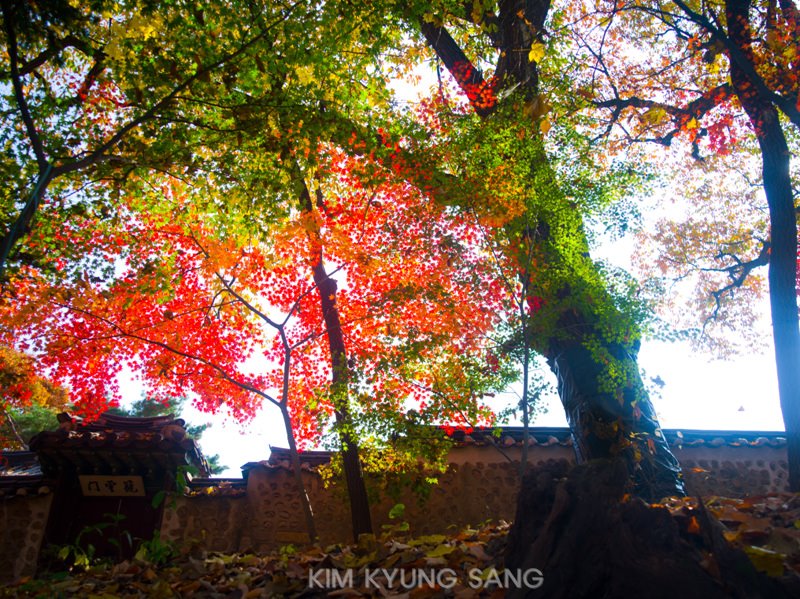
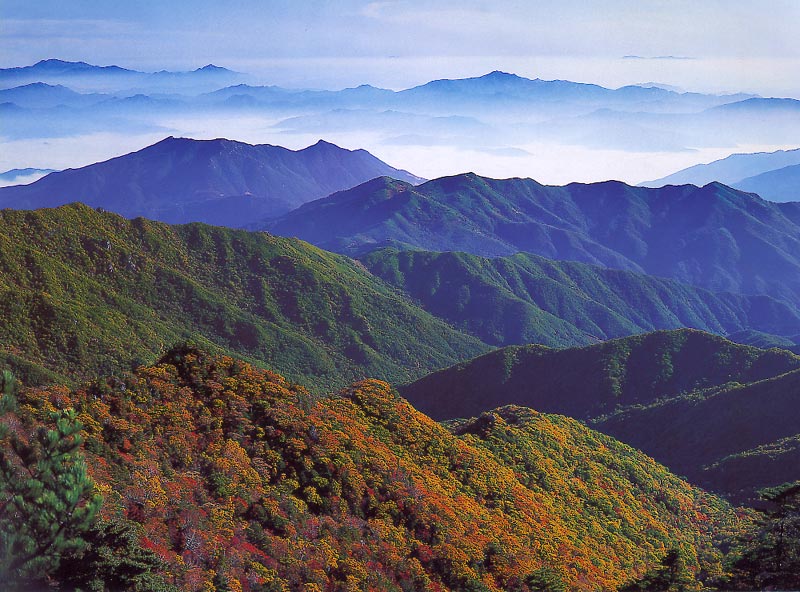
Photographed by Kim Kyung-sang

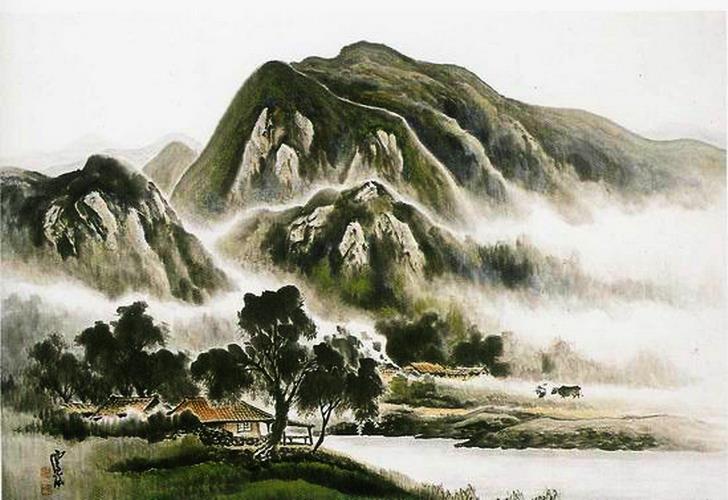
Autumn Letter by Koh Jung-hee

The day Autumn waited to ripen,
it swelled to the edge of the Black Dragon River.
Despairing that my love couldn’t ripen,
I cut off the road that led to you,
but inside my heart was a road
and I couldn’t cut off the road of my heart.

The day Autumn deepened spectacularly,
it illuminated the foothills of Sumi Mountain.
Angry that my love couldn’t deepen,
I closed the door that opened toward you,
but inside my heart was a door
and I couldn’t close up the door of my heart.

Wet with the tears of inky rain,
Autumn turned around and left me.
Sorrowful that I couldn’t let go of my love,
I cut off the branch that reached out to you,
but inside my heart were bountiful branches
and I couldn’t cut off a branch of my heart.

Though I cut the road and closed the door,
though I close the door and cut the branch,
you arrive as the evening river.
Though, with a horse’s bit, I restrain myself from longing,
though I press down the sprouting thought of you with a rock,
you shake as the vast field of grass.
Since even the sun and the moon cannot rest upon that field,
again I might have to open another road.
Again I might have to open another door.
Bound for the South by Koh Jung-hee

Translated by Chae-Pyong Song and Anne Rashid

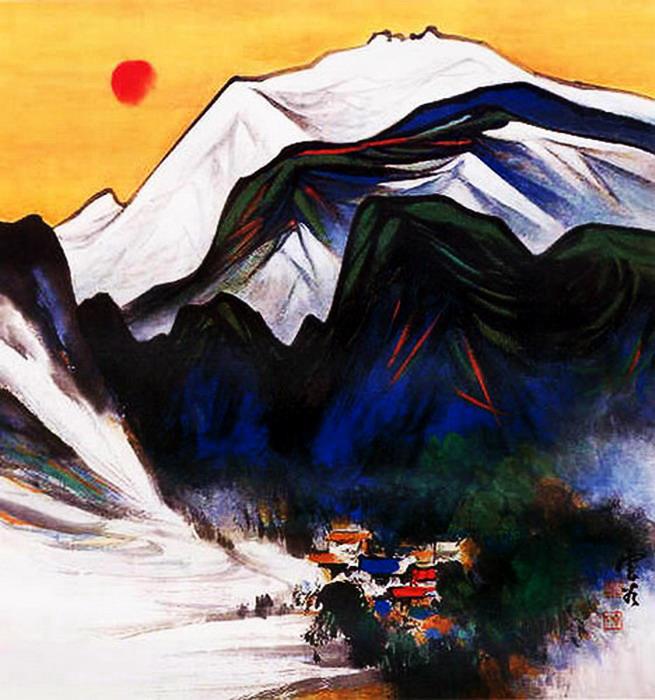
Painted by Kang Jang-won (Mudeung Mountain in Gwangju, Korea)

Bound for the South by Koh Jung-hee

When the moon is full in mid-July, envisioning home,
I run down the road to Haenam, the place that I miss–
the road I take to watch the evening glow below Mother’s grave,
the road the typhoons Thelma, Alex, Vernon, and Win swept over,
the road that the floods ravaged and devilish waters shredded.

The end of the peninsula, the clouds of solitary spray.
Giving my heart to the South, to the South,
I suddenly want to bow, putting my two hands together.
Passing the Honam Plain, I want to bow.

The rice stalks that sway vibrantly
are like the veins of Father hunching over the field.
The horseweed flowers that bloom wildly
are like Mother’s attentive care that lingers
around the mountains and streams of my home.

The Mudeung Mountain that rises up purely,
the white-naped crane that hops,
the white poplar tree that dazzles–
today these do not look ordinary,
and I want to bow to the picturesque landscape.
I want to kneel down and kiss the land of the South.

남도행/ 고정희

칠월 백중날 고향집 떠올리며
그리운 해남으로 달려가는 길
어머니 무덤 아래 노을 보러 가는 길
태풍 셀마 앨릭스 버넌 윈이 지난 길
홍수가 휩쓸고 수마가 할퀸 길

삼천리 땅 끝, 적막한 물보라
남쪽으로 남쪽으로 마음을 주다가
문득 두 손 모아 절하고 싶어라
호남평야 지나며 절하고 싶어라

벼포기 싱싱하게 흔들리는 거
논밭에 엎드린 아버지 힘줄 같아서
망초꽃 망연하게 피어 있는 거
고향 산천 서성이는 어머니 잔정 같아서

무등산 담백하게 솟아 있는 거
재두루미 겅중겅중 걸어가는 거
백양나무 눈부시게 반짝이는 거
오늘은 예삿일 같지 않아서
그림 같은 산과 들에 절하고 싶어라
무릎 꿇고 남도땅에 입맞추고 싶어라

(Originally published in The Gwangju News, August, 2011)

A Firefly by Kim Nam-ju

Translated by Chae-Pyong Song and Anne Rashid

Photographed by Chae-Pyong Song in Costa Rica

A Firefly by Kim Nam-ju

On the empty field
darkness thickens.
To my ears, water flows.
The sound is clear,
and a firefly on a grass field
stays awake and
flickers on and off.

Firefly, don’t sleep.
If your light disappears in this night,
who can I befriend?
With whom can I spend these dark times?

The night deepens
and at last
the eastern sky brightens.

The firefly has disappeared
and only I remain, alone—
at the end of darkness
I greet the morning that brightens.

The dew dangling on the grass
looks beautiful in the morning sunlight.

Someday in heaven
I will live as a poet
who sings about you, firefly,
reincarnated as the dew.

개똥벌레 하나/ 김남주

빈 들에
어둠이 가득하다.
물 흐르는 소리
내 귀에서 맑고
개똥벌레 하나 풀섶에서
자지 않고 깨어나 일어나
깜박깜박 빛을 내고 있다.

그래
자지 마라 개똥벌레야
너마저 이 밤에 빛을 잃고 말면
나는 누구와 동무하여
이 어둠의 시절을 보내란 말이냐

밤은 깊어가고
이윽고
동편 하늘이 밝아온다.

개똥벌레는 온데간데없고
나만 남아 나만 남아
어둠의 끝에서 밝아오는
아침을 맞이한다.

풀잎에 연 이슬이
아침 햇살에 곱다.

개똥벌레야
나는
네가 이슬로 환생했다고
노래하는 시인으로 살련다.
먼 훗날 하늘나라에 가서. . .

Kim Nam-ju (1946-1994) was born in Haenam, Jeollanam-do and studied English at Chonnam National University. He is known as one of the major resistance poets in South Korea, leading the people’s movement in the 1970s and 80s that ultimately toppled the dictatorship in Korea. Because of his activism, he was imprisoned twice, for more than ten years in total. In prison where paper and pencil were not allowed, he wrote many poems on milk cartons with the nail he made by grinding a toothbrush. These poems were later published in two collected volumes of his prison poetry, The Sunlight on the Prison Bar. His poetry bears witness to the tyranny of dictatorship and the hardships of the oppressed. He published such poetry collections as Requiem, My Sword My Blood, One Fatherland, The Weapon of Love and In This Lovely World. He received the Yun Sang-won Literary Award in 1993 and the National Literary Award in 1994. His poems have also been memorialized by Korean activist, rock singer An Chi-hwan in his album entitled “Remember.”

Gazing at Mudeung Mountain by Seo Jung-ju

Translated by Chae-Pyong Song and Anne Rashid

Painted by Kang Jang-won (Mudeung Mountain in Gwangju, Korea)

Gazing at Mudeung Mountain by Seo Jeong-ju

Poverty is no more than tattered rags.
Can it cloak our inborn flesh, our natural heart
like the summer mountain
that stands baring its dark green back to the dazzling sun?

As the green mountain tends to orchids under its knees,
all we can do is nurture our offspring.

Husbands and wives,
as you meet the afternoon
when life retreats and gets swept up in rough waves,
once in a while sit down,
once in a while lie next to each other.

Wives, gaze silently at your husbands.
Husbands, touch also your wives’ foreheads

Even when we lie in the pit of a thorn bush,
we should always remember that we are just gems, buried alone,
thickly covered with green moss.

무등을보며/ 서정주

가난이야 한낱 남루(襤褸)에 지나지 않는다.
저 눈부신 햇빛 속에 갈매빛의 등성이를 드러내고 서 있는 여름 산 같은
우리들의 타고난 살결, 타고난 마음씨까지야 다 가릴 수
있스랴.

청산이 그 무릎 아래 지란(芝蘭)을 기르듯
우리는 우리 새끼들을 기를 수밖에 없다.

목숨이 가다 가다 농울쳐 휘어드는
오후의 때가 오거든
내외들이여 그대들도
더러는 앉고
더러는 차라리 그 곁에 누워라.

지어미는 지애비를 물끄러미 우러러보고
지아비는 지어미의 이마라도 짚어라.

어느 가시덤불 쑥구렁에 놓일지라도
우리는 늘 옥돌같이 호젓이 묻혔다고 생각할 일이요
청태(靑苔)라도 자욱이 끼일 일인 것이다.

Seo Jeong-ju (1915 – 2000) was born in Gochang, Jeollabuk-do. He is considered the founding father of modern Korean poetry. Under the pen name Midang, he published at least 15 collections of poetry. He taught Korean literature at Chosun University, among others. He was also nominated five times for the Nobel Prize in literature. His grandmother’s stories and his interest in Buddhism had a strong influence upon his writing. His works have been translated into a number of languages, including English, French, Spanish and German.

NB: Read Moon Byung-ran’s “Poverty” as a pair:
https://jaypsong.wordpress.com/category/moon-byung-ran/

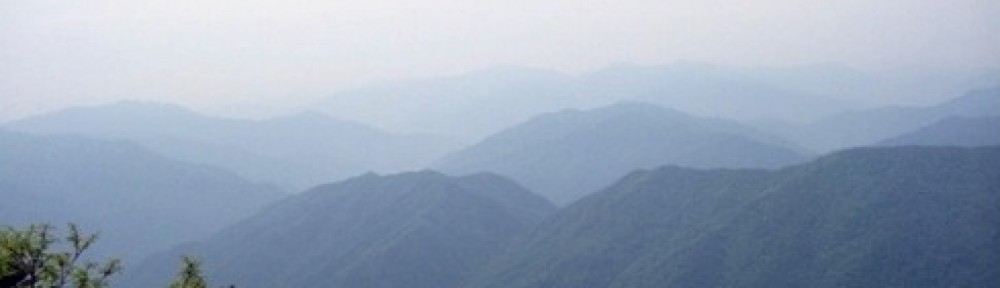
Preface Poem by Koh Jung-hee

Translated by Chae-Pyong Song and Anne Rashid

Jiri Mountain, Korea

Preface Poem by Koh Jung-hee

I climb the mountain, carrying the weight of my life.
When I collapse at the summit where I cannot climb further,
washing away the sweat that gushes up,
there the mountain takes on the weight of my life
and hangs it green on the ridge:
the mountain

I climb the mountain, carrying sorrow.
When, leaning against the sorrows of the twelve summits rising ahead,
I take off the sorrow as tall as me,
there the mountain takes on the burden of my sorrow
and scatters it over the clean water of twelve valleys:
the mountain, the mountain

I climb the mountain, carrying solitary days,
and when I meet the ridge dizzy with wild flowers,
and bury the loneliness as big as my life,
there it takes on the burden of my loneliness
and makes my heart tender and peaceful:
the mountain, the mountain, the mountain

As we spin the way of revolution from the wheel of history,
do people hold one another’s hands to spin the way of love?
Standing on the mountain path with more mountains ahead,
when I cry over the thought of you that pierces deep into my bones,
there the mountain receives the tears of my love,
and opens the dazzling field of royal azaleas:
the mountain, the mountain, the mountain

(Originally published in The Gwangju News, August, 2011)

Koh Jung-hee (1948 – 1991) was born in Haenam, Jeollanam-do, and studied at Hanshin University. A passionate feminist, she often offered sharp criticism on modern Korean society, whether it was political oppression or gender inequality. In June, 1991, she died, swept up by a torrential rain, while climbing up the Snake Valley of Jiri Mountain, a mountain she loved a great deal and wrote about often. Known for resistance poetry, particularly based upon the Gwangju Uprising, as well as for lyric poems, she derived many of her poetic inspirations from Gwangju and Jeolla-do (often known as Nam-do). In her lifetime she published at least ten collections of poetry and received the Korean Literature Award in 1983.

The Long Quiet by Shin Byong-eun

Translated by Chae-Pyong Song and Anne Rashid

Painted by Kang Jang-won

The Long Quiet by Shin Byong-eun

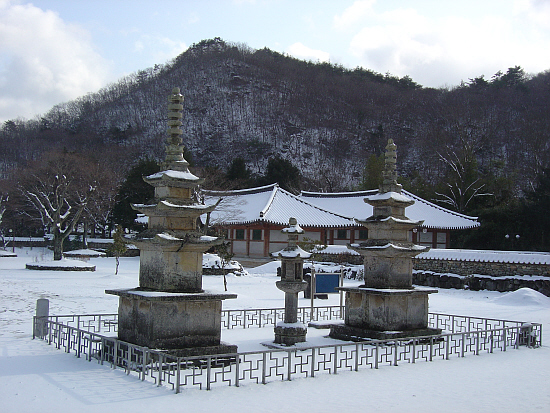
I stand in front of two stone pagodas standing side by side
at Borim Temple at the foot of Gaji Mountain.
In that proximity,
they withstood the longing, unable to touch hands for a thousand years–
they even lit the translucent stone lantern.
Alongside the long silence that shines as it flies,
I put down one heart that has endured more than my life,
so I feel calm
when I take off my shoes neatly and quietly enter the hall.
The door silently opens to welcome me,
then the Buddha’s reliquary hall deepens as much as possible,
and it blooms into the silent stone flower of eternity.
The Word of silence responds to quiet praying
with a quiet smile—
you and I become silent, too.
It would be wonderful if you,
who were passionate once
and stayed for a short while before leaving,
could become a quiet, sunlit morning. 

오랜 고요

가지산 기슭의 보림사
나란한 삼층석탑 앞에 섭니다
그만큼의 거리로
천년 세월 손닿지 못한 그리움을 견디려
창 맑은 석등까지 밝혔습니다
날아가며 빛나는 오랜 고요 곁에
생애보다 더 견뎌온 마음 하나 내려놓습니다
덕분에 고요해졌습니다
신발 가지런히 벗어두고 살그머니 들어서면
말없이 문을 열어 나를 받아들입니다
그럴 때면 적멸궁은 깊어질 대로 깊어져
영겁의 고요로운 석꽃을 피웁니다
묵언발원의 끝말을 이으며
소리 없이 씨익 웃는 고요의 그 말씀에
너도 나도 그렇게 고요해질 뿐입니다
한 세월이 뜨거워
잠시 머물렀다 떠난 그대도
지금쯤 햇살 고요한 아침이면 좋겠습니다

Borim Temple (Jangheung, Korea)

A Letter from Odong-do by Shin Byong-eun

Translated by Chae-Pyong Song and Anne Rashid

Painted by Kim Seon-soo

A Letter from Odong-do

As people set their feet upon it,
the island’s breast firmly rises like a girl’s.
Every place the winter’s wind gets pushed away,
the breath of the people, whom spring touches earliest, is clear.
The island breathes in people’s breaths,
holds their wounds,
rolls its eyes at the edge of the cliff leading to empty air,
enters into the shadow where the white eye cries clearly
and eats a meal of wind.
Even when one whispers Odong-do,
she is surprised to the extent her waist bends,
and then adjusts her dress of white waves.
Even the sea that throws a seed of sunlight over every furrow of waves
stops for a moment to put a hand on her forehead,
and whistles into the clear wind.
People become shadows on the edge of the island
And will turn into a forest of camellias.

오동도에서 보내는 편지

발길이 닿자
섬은 소녀처럼 탱글하게 가슴이 부푼다
겨울바람을 밀어낸 자리마다
가장 먼저 봄이 닿은 사람들의 바람소리 맑다
섬은 사람들의 숨을 마시고
섬은 사람들의 상처를 받아들고
허공으로 길을 낸 벼랑 끝에 눈망울 굴리다
동박새 울음 맑은 그늘로 들어
바람의 한 끼 식사를 한다
오동도 하고 누가 속살대기만 해도
허리 젖혀 자지러지다
파도 하얀 옷춤을 여미곤 한다
파도의 이랑마다 햇살의 씨앗을 뿌리던 바다도
잠시 이마에 손을 얹고
바람 맑은 휘파람을 불어준다
섬의 가장자리에서 그늘이 된 사람들
동백숲이 된다

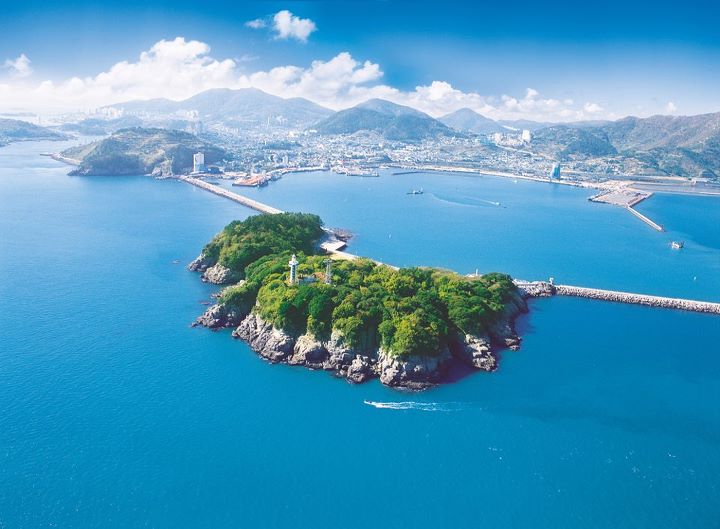
A Photo of Odong-do, Yeosu, Korea

The Road to Yeosu by Shin Byong-eun

Translated by Chae-Pyong Song and Anne Rashid

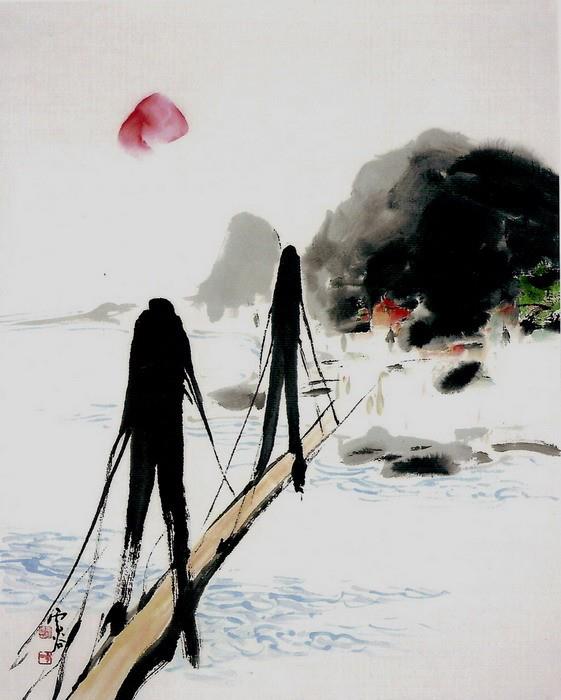
Painted by Kang Jang-won (Dolsan Bridge, Yeosu, Korea)

The Road to Yeosu by Shin Byong-eun

Friend,
suddenly you may feel the world is too much;
you may feel you are the only one in the world.
When you shake your head in the dead-end alley,
and say, “No, this is not it. This is not it,”
come to Yeosu at once, lightly,
throwing away all the burdens in your heart.
To you who have run a long way,
the generous rolling sea
and the islands that resemble wind
will softly whisper–
what shakes is not the core;
what shakes lasts only for a moment.
Showing you that living can be so light at times,
she will make a seaweed soup
and relieve you of your tangled and knotted life.
Friend,
knowing how lonely you were,
the smiling camellia, returning after the biting winter,
will untie her dress and rush to hold you.  

여수 가는 길/ 신병은

자네,
문득 세상살이 힘들 때가 있지
세상에 덜렁 혼자뿐이라고
아니다 아니다 이게 아니라고
막다른 골목에서 고개를 흔들 때
마음의 짐일랑 그대로 팽개치고
빈 몸 그대로 곧장 여수로 오시게
먼 길 달려온 자네에게
늘 넉넉하게 일렁이는 바다가
바람을 닮은 섬들이
흔들리는 것은 결코 중심은 아니라고
흔들리는 것은 잠시일 뿐이라고
넌지시 귀띔해 줄 걸세
때로는 사는 것이 얼마나 가벼운 거냐며
생미역 한 줄기 풀어
엉기고 맺힌 생을 해장시켜 줄 걸세
자네, 외로움이 얼마나 심했냐고
겨울 이기고 돌아온 동백꽃 웃음이
옷깃을 풀고 와락 안겨들 걸세

Shin Byong-eun (1955 – ) was born in Changnyong, Gyongsangnam-do. His poetry collections include Blades of Grass with Wind, Greeting the Vegetable Morning, The Sleep of Grasses on the Other Side of the River, How to Fire Wind, and The Scenery of Poems and Paintings. He was awarded the Jeonnam Poetry Award, the Yeosu Arts and Culture Award, and the Hanryo Literary Award. Currently he teaches at Yeosu Information Science High School and serves as a chairperson of Yeosu Branch of the Federation of Arts and Culture Organizations of Korea.

YouTube version: http://www.youtube.com/watch?v=u72_Gf2e0JY

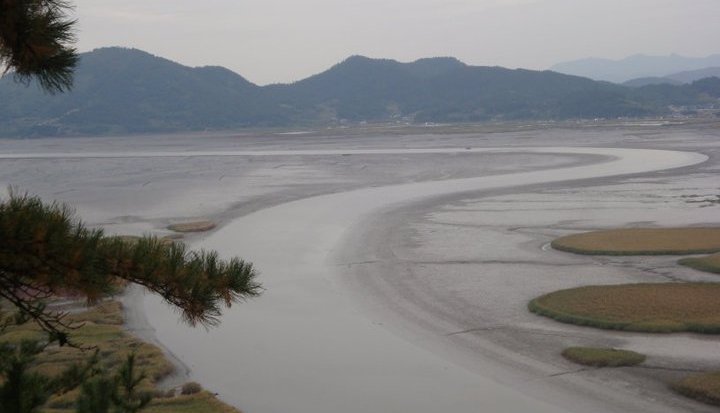
At a River Village at Dusk by Moon Tae-jun

Translated by Chae-Pyong Song and Darcy Brandel

Photographed by Chae-Pyong Song (Suncheon Bay, Korea)

At a River Village at Dusk by Moon Tae-jun

Even in my insensitivity I come to think of you sometimes
Sorrow moves like a mountain shadow across your eyes

A bird cries like an echo in a glazed pot but the river, a bigger pot, contains her

In the distance between you and me
between the darkness of this place and that of the village beyond
the river like a big round wheel flows

A cow cries at the village across the river
I cannot help the cow whose cries dampen the cold river with drizzle
Perhaps she just lost her baby or her love
I cannot help the cow who cries till her voice gets hoarse
I cannot forget the crying cow’s white round eyes

Even in my insensitivity I come to think of you sometimes

(Originally published in Azalea: Journal of Korean Literature and Culture, Volume 4 [2011])

moontaejunphotoMoon Tae-jun (1970-) has published four collections of poetry: Chattering Backyard(2000), Bare Foot (2004), Flatfish (2006), and Shadow’s Development (2008) as well as other essays and commentary. One of the most popular poets of the younger generation, Moon uses deceptively simple poetic language with profound lyricism, commenting on the struggle of daily life. Grounded in Buddhist philosophy, his poems speak with reverence for all forms of life and emphasize the necessity of emptying oneself. Moon is a recipient of many prestigious awards, including the Dongseo Literature Award (2004), the Midang Literature Award (2005), and the Sowol Poetry Award (2007).

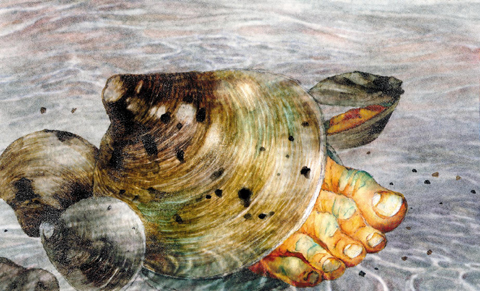
Bare Foot by Moon Tae-jun

Translated by Chae-Pyong Song and Darcy Brandel

Illustrated by Kwon Shina

Bare Foot by Moon Tae-jun

A clam at the fish store pushes a bare foot outside its mud hut
sticking out its bare foot
the way the dead Buddha reaches out for the disciple who cries sorrowfully
Immersed long in flatland and water the foot has wrinkled up
When I touch its bare foot with reverence the clam
slowly withdraws as if having the first thought, as if having the longest thought
At that speed even time, even road might have flown
Anyone might have gone out or, separated, might have come back slowly like that
Always barefoot I guess
As the bird having lost its love endures the night with beak buried into chest
so might the clam have endured sorrow with foot buried into chest
When the house cried for food
he might have gone out to beg barefoot, blistered
After all day in the street
perhaps he returned to the hut reeking with poverty
the house content, full of food
its crying stopped, quiet as darkness

(Originally published in Azalea: Journal of Korean Literature and Culture 4)

moontaejunphotoMoon Tae-jun (1970-) has published four collections of poetry: Chattering Backyard(2000), Bare Foot (2004), Flatfish (2006), and Shadow’s Development (2008) as well as other essays and commentary. One of the most popular poets of the younger generation, Moon uses deceptively simple poetic language with profound lyricism, commenting on the struggle of daily life. Grounded in Buddhist philosophy, his poems speak with reverence for all forms of life and emphasize the necessity of emptying oneself. Moon is a recipient of many prestigious awards, including the Dongseo Literature Award (2004), the Midang Literature Award (2005), and the Sowol Poetry Award (2007).