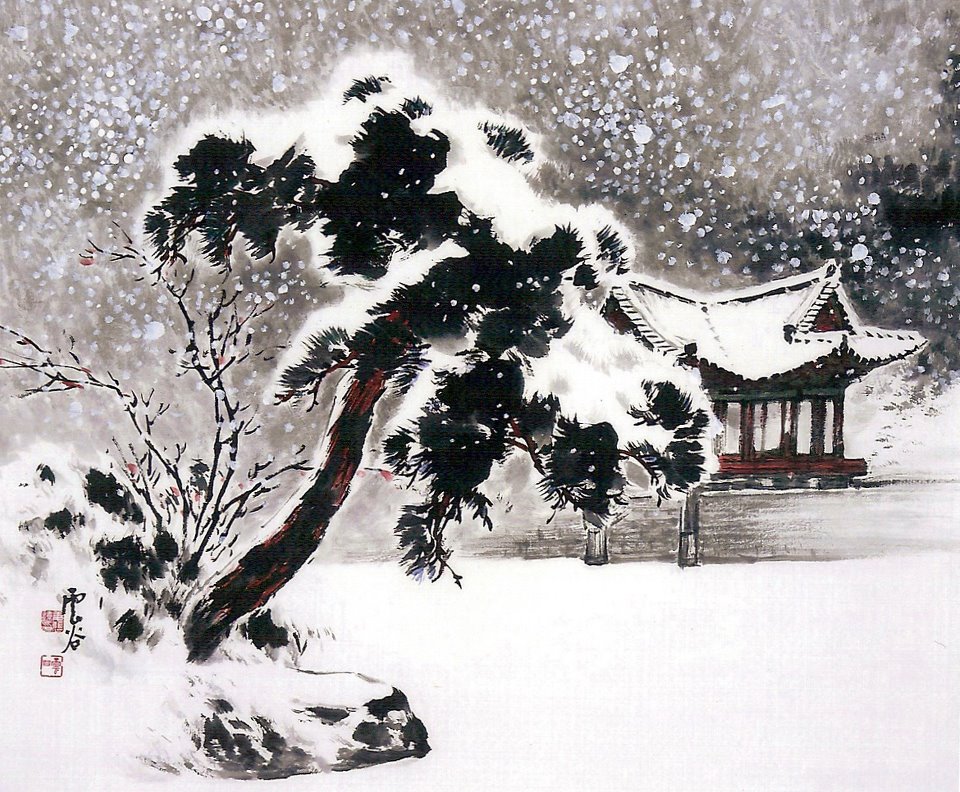
The Winter Tree by Lee Jae-mu

Translated by Chae-Pyong Song and Anne Rashid
Painted by Heo Hae-jung

The Winter Tree by Lee Jae-mu

When leaves were thick,
I couldn’t see clearly.
Even the sky was covered
and the area around my feet was dark.
The leaves fell when the frost descended.
With stems and branches only, I have endured
a time punctured with holes all over,
and have been stricken by wind.
Now I can see an old friend in the far off distance
and my good neighbor coming closer.
The winter tree is lonely and thus, strong.

겨울나무/이재무

이파리 무성할 때는
서로가 잘 뵈지 않더니
하늘조차 스스로 가려
발밑 어둡더니
서리 내려 잎 지고
바람 매 맞으며
숭숭 구멍 뚫린 한 세월
줄기와 가지로만 견뎌보자니
보이는구나, 저만큼 멀어진 친구
이만큼 가까워진 이웃
외로워서 단단한 겨울나무

A Winter Love by Moon Jung-hee

Translated by Chae-Pyong Song

Photography by Hye Hyon

A Winter Love by Moon Jung-hee

Like snow flakes I long to come to you.
Without wavering
without rambling
without concealing
I long to plunge into your white life
and become a warm winter.
I long to snow for a thousand years.

겨울 사랑 – 문정희

눈송이처럼 너에게 가고 싶다.
머뭇거리지 말고
서성대지 말고
숨기지 말고
그냥 네 하얀 생애 속에 뛰어들어
따스한 겨울이 되고 싶다.
천년 백설이 되고 싶다.

(이 세상 모든 사랑은 무죄이다, 1998)

(Darcy Brandel read an earlier version of this translation.)

Mun Jung-hee (1947- ) was born in Bosung, Jeollanam-do. She received her Ph.D. from Seoul Women’s University. She made her literary debut in 1969 in The Literature Monthly. Her poetry collections include The Baby BrierFor MenNow Following the Rose, I am the Door, The Joy of Love, and The Prolific Virgin. She received such prestigious awards as the Modern Literature Award and the Sowol Poetry Award.

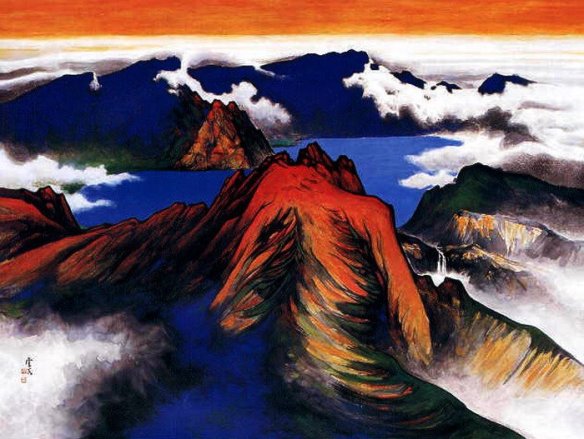
Love Song for the Hill of Limits by Moon Jung-hee

Translated by Chae-Pyong Song and Anne Rashid

Painted by Kang Jang-won

Love Song for the Hill of Limits by Moon Jung-hee

In deep winter, as I drive over Hangyeryong, the Hill of Limits
with the one I love
I would like to run into an unexpected snow storm.
The news networks compete to report the most snow in a decade.
Sputtering along,
the cars hurry to return to their spots,
but I would rather be held up, overwhelmed by the limits of Hangyeryong.

Oh, the blinding isolation—
would that my fate, not my feet, be held up here
in this fairytale land surrounded by white in all four directions.

When the day quickly darkens,
the abundant snow will turn to terror little by little,
and reality will begin to cast the color of fear.
Even when a helicopter appears,
I would never wave my hand,
even when it drops food
for the wild birds and animals trapped in the snow.

Even when the helicopters,
which sprayed dark bombs
toward the newly alive, young hearts,
mercifully drop the rations evenly
for the daily meals of the  elk and pheasants,
I will not even show the hem of my dress.

I would not know what to do with this brief blessing,
willingly kept by the beautiful Hangyeryong.

한계령을 위한 연가/ 문 정 희

한겨울 못 잊을 사람하고
한계령쯤을 넘다가
뜻밖의 폭설을 만나고 싶다.
뉴스는 다투어 수십 년 만의 풍요를 알리고
자동차들은 뒤뚱거리며
제 구멍들을 찾아가느라 법석이지만
한계령의 한계에 못 이긴 척 기꺼이 묶였으면.

오오, 눈부신 고립
사방이 온통 흰 것뿐인 동화의 나라에
발이 아니라 운명이 묶였으면.

이윽고 날이 어두워지면 풍요는
조금씩 공포로 변하고, 현실은
두려움의 색채를 드리우기 시작하지만
헬리콥터가 나타났을 때에도
나는 결코 손을 흔들지는 않으리.
헬리콥터가 눈 속에 갇힌 야생조들과
짐승들을 위해 골고루 먹이를 뿌릴 때에도…

시퍼렇게 살아 있는 젊은 심장을 향해
까아만 포탄을 뿌려대던 헬리콥터들이
고라니나 꿩들의 일용할 양식을 위해
자비롭게 골고루 먹이를 뿌릴 때에도
나는 결코 옷자락을 보이지 않으리.

아름다운 한계령에 기꺼이 묶여
난생 처음 짧은 축복에 몸둘 바를 모르리.

(Originally published in The Gwangju News, January, 2012)
Mun Jung-hee (1947- ) was born in Bosung, Jeollanam-do. She received her Ph.D. from Seoul Women’s University. She made her literary debut in 1969 in The Literature Monthly. Her poetry collections include The Baby Brier, For Men, Now Following the Rose, I am the Door, The Joy of Love, and The Prolific Virgin. She received such prestigious awards as the Modern Literature Award and the Sowol Poetry Award.
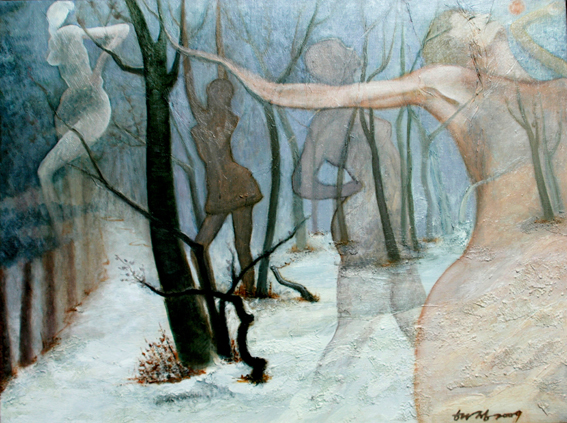
A Winter Diary by Moon Jung-hee

Translated by Chae-Pyong Song and Anne Rashid

Painted by Kang Jang-won

A Winter Diary by Moon Jung-hee

I have spent this winter lying down.
I have lost my loved one–
the monologues have ended
that I rolled, shiny like a rosary;
the wind has stopped,
and I have spent this winter comfortably, lying down.

Even when the naked trees in that field cry because they are cold,
even when they become a forest, leaning on one another–
having nothing to do with them, I never bothered to open the door even once;
like a ruminant, I took out only death to chew.

I spent this winter
comfortably, lying down
when I lost my loved one.

겨울 일기 / 문정희

나는 이 겨울을 누워 지냈다.
사랑하는 사람을 잃어버려
염주처럼 윤나게 굴리던
독백도 끝이 나고
바람도 불지 않아
이 겨울 누워서 편히 지냈다.

저 들에선 벌거벗은 나무들이 추워 울어도
서로 서로 기대어 숲이 되어도
나는 무관해서 문 한번 열지 않고
반추동물처럼 죽음만 꺼내 씹었다.

나는 누워서 편히 지냈다.
사랑하는 사람을 잃어버린
이 겨울.

(Originally published in The Gwangju News, January, 2012)

Mun Jung-hee (1947- ) was born in Bosung, Jeollanam-do. She received her Ph.D. from Seoul Women’s University. She made her literary debut in 1969 in The Literature Monthly. Her poetry collections include The Baby Brier, For Men, Now Following the Rose, I am the Door, The Joy of Love, and The Prolific Virgin. She received such prestigious awards as the Modern Literature Award and the Sowol Poetry Award.
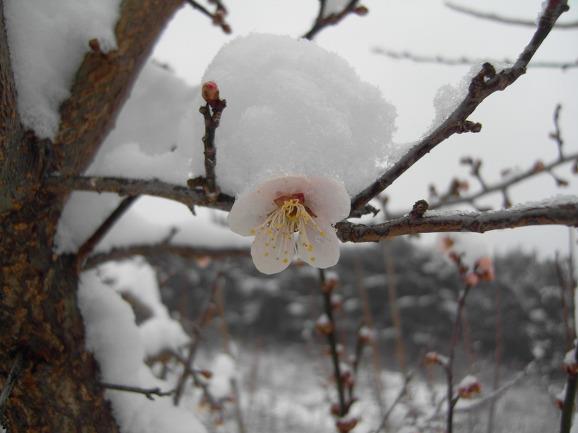
Winter’s Dance by Kwak Je-gu

Translated by Chae-Pyong Song and Anne Rashid

Painted by Kang Jang-won

Winter’s Dance by Kwak Je-gu

Before the first snow falls,
I must mend the memory window.
Brushing off the dust of despair and sorrow
piling up during the past seasons,
I must drive a new nail of waiting
into the edge of the creaking window frame.
I must take down the old curtain
hung without meaning,
light a small kerosene lamp
that won’t go out even in below-zero cutting wind,
and learn winter’s cold and shining dance.
The world is a lovely place depending how you look at it—
a place that dreams of the progress of a new world
where passionate love, labor, revolution, and touching go together.
Winter is rather warm if you embrace it.

겨울의 춤/ 곽재구

첫눈이 오기 전에
추억의 창문을 손질해야겠다.
지난 계절 쌓인 허무와 슬픔
먼지처럼 훌훌 털어내고
삐걱이는 창틀 가장자리에
기다림의 새 못을 쳐야겠다.
무의미하게 드리워진
낡은 커튼을 걷어내고
영하의 칼바람에도 스러지지 않는
작은 호롱불 하나 밝혀두어야겠다.
그리고… 차갑고도 빛나는 겨울의 춤을 익혀야겠다.
바라보면 세상은 아름다운 곳
뜨거운 사랑과 노동과 혁명과 감동이
함께 어울려 새 세상의 진보를 꿈꾸는 곳
끌어안으면 겨울은 오히려 따뜻한 것

Kwak Je-gu (곽재구) was born in Gwangju in 1954. He studied Korean literature at Chonnam National University. He made his literary debut as a poet with “At Sapyung Station,” which won the Spring literary award organized by the Joongang Daily in 1982. From 1981 to 1987, he worked as a member of “May Poetry,” a group of creative writers deeply inspired by the Gwangju Uprising in 1980. His poetry collections include At Sapyung Station, Jeonjang-po Arirng, Korean Lovers, A Song of Seoul and The Clear Current. He currently teaches creative writing at Suncheon National University. In 1996, he received the Dongseo Literary Award.