The Entrance of Seonun Temple by Seo Jung-ju

Translated by Chae-Pyong Song

Painted by Kang Jong-ryeol

The Entrance of Seonun Temple by Seo Jung-ju

To the gully of Seonun Temple
I went to see camellias blooming.
But it was too early for them;
Like the woman’s folk song
drifting from the rice-wine pub
only last year’s are still left
in as hoarse a voice as hers.

선운사 동구(洞口)/ 서 정 주

선운사 고랑으로
선운사 동백꽃을 보러 갔더니
동백꽃은 아직 일러 피지 않았고
막걸릿집 여자의 육자배기 가락에
작년 것만 시방도 남았습니다.
그것도 목이 쉬어 남았습니다.

(Darcy Brandel and Melanie Steyn read the earlier versions of this translation.)

Seo Jeong-ju (1915 – 2000) was born in Gochang, Jeollabuk-do. He is considered the founding father of modern Korean poetry. Under the pen name Midang, he published at least 15 collections of poetry. He taught Korean literature at Chosun University, among others. He was also nominated five times for the Nobel Prize in literature. His grandmother’s stories and his interest in Buddhism had a strong influence upon his writing. His works have been translated into a number of languages, including English, French, Spanish and German.

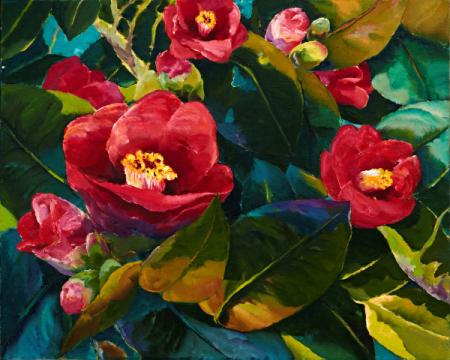
Camellia at Seonun Temple by Kim Yong-taek

Translated by Chae-Pyong Song

Painted by Kang Jong-rae

Camellia at Seonun Temple by Kim Yong-taek

Rejected by a woman,
I crossed barefoot
the icy gully of Seonun Temple,
biting my teeth
at the freezing water that ached my feet,
Telling myself
I will not cry again
just because of that love,
just because of that woman,
I hid my tears.
But when I went to the backyard of Seonun Temple
with its camellias bursting red,
I wailed.

선운사 동백꽃김용택

여자에게 버림 받고
살얼음 낀 선운사 도랑물을
맨발로 건너며
발이 아리는 시린 물에
이 악물고
그까짓 사랑 때문에
그까짓 여자 때문에
다시는 울지말자
다시는 울지말자
눈물을 감추다가
동백꽃 붉게 터지는
선운사 뒤안에 가서
엉엉 울었다.

(Darcy Brandel and Melanie Steyn read the earlier versions of this translation.)

Kim Yong-taek (1948- ) was born in Imsil, Jeollabuk-do. With lyrical (often regional) vernacular, he has written many poems about undamaged agricultural communities and the profound beauty of nature. His poetry collections include The Sumjin River,A Clear DaySister, The Day Is Getting DarkThe Flower Letter I MissTimes Like A RiverThat Woman’s House, and Your Daring Love. He also published essay collections such as A Small Village,What’s Longed for Exists behind the MountainA Story of the Sumjin River, and Follow the Sumjin River and Watch. He was awarded the Kim Soo-young Literary Award (1986) and the Sowol Poetry Award (1997). He currently teaches at Woonam Elementary School.

If We Could Meet in Water by Kang Eun-kyo

Translated by Chae-Pyong Song

Photography by Daeseock Seo

If We Could Meet in Water by Kang Eun-kyo

If we could become water and meet
Wouldn’t any family of drought welcome us?
If we could stand along with tall trees
And flow in roaring rain.

If we could flow endlessly
and moisten the dead root,
lying on the river that deepens alone.
Ah, if we could reach the shy sea
That is still a virgin.

But now
we try to meet in fire.
A bone that has become charcoal
cradles the things still burning in the world.

Beloved, who waits ten thousands Li outside,
Let us meet, after the fire passes by,
in water that flows.

When you come,
come to the spacious, clean sky where footsteps disappeared,
speaking in the sound that fire hisses

우리가 물이 되어/ 강은교

우리가 물이 되어 만난다면
가문 어느 집에선들 좋아하지 않으랴.
우리가 키 큰 나무와 함께 서서
우르르 우르르 비오는 소리로 흐른다면.

흐르고 흘러서 저물녘엔
저 혼자 깊어지는 강물에 누워
죽은 나무 뿌리를 적시기도 한다면.
아아, 아직 처녀(處女)인
부끄러운 바다에 닿는다면.

그러나 지금 우리는
불로 만나려 한다.
벌써 숯이 된 뼈 하나가
세상에 불타는 것들을 쓰다듬고 있나니.

만 리 밖에서 기다리는 그대여
저 불 지난 뒤에
흐르는 물로 만나자.

푸시시 푸시시 불 꺼지는 소리로 말하면서
올 때는 인적 그친
넓고 깨끗한 하늘로 오라.

(Darcy Brandel read an earlier version of this translation.)

Jesus of Seoul by Chung Ho-seung

Translated by Chae-Pyong Song

Painted by Kim Seon-soo

Chung Ho-seung, “Jesus of Seoul”

1

Jesus casts a fishing rod and sits by the Han River.
He makes a campfire at the riverside and dries his wet clothes.
Every day wild grass collapses, pierced by the swords of humans,
and a flower of a human that is like grass blooms and withers.
To see humans become beautiful, Jesus, who is wet with the winter rain,
is crying, leaning against the wall of the Westgate detention center.

2

In the drunken evening, Jesus’ long shadow is moving beyond the horizon.
Over the back of Jesus, who has begged a bowl of cold rice,
a crescent quickly rises. Was there overflowing peace in suffering,
longed-for freedom in tears? Thinking of the bread and love of Seoul,
the bread and tears of Seoul, Jesus is smoking alone.
He watches people disappear into a human dew.
At night people sleep, chewing on sand.
Leaves stay in Seoul for a moment in order to leave,
and Jesus is walking toward the end of despair.

3

Thirsty. I feel thirsty because people’s dreams are gone before Seoul sleeps.
Where is someone walking, holding a lamp?
I can’t see the pathways of Seoul, and you collapse
on the heap of ashes every night and cry, tearing down the cloak.
At the sound of a gunshot, snow falls,
and into the depth of love and faith the first snow falls.
I find no place to throw a stone I grabbed in Seoul.
My beloved, I miss you again.  Lift your cup with me.
Nowhere in Seoul’s night sky where snow is falling
can I rest my head for a moment, so please lift your cup with me.
You whose chest has collapsed at knife point,
carrying a glass, walking into darkness,
escaping from the knife point of this world,
walk Seoul’s snow-covered path till snow stops falling.
The lamps of the evil have not been extinguished yet,
and the silent ears of a human who strains to hear
the dawn of Seoul has been wet by grass blades. I am thirsty.
Ah, I am thirsty because the dreams of Seoul are gone before people sleep.

4

I want to drink a human cup.
I want to meet a person of beautiful memories
and exchange Soju cups and share mung-bean pancakes made of tears.
I want to hear a human’s dress brush grass blades on a spring day
when a petal falls like a knife,
and want to live in the country of people rather than the country of hearts.
I want to kindle alone the lamp of Seoul
so that human lamps will not go out on at dawn;
I yearn for the longing of Seoul,
leaning against a poor person’s window.

5

Those who worship me are sorrowful,
and those who feel sad for me are sorrowful.
Those who are joyful for me are sorrowful,
and those who mourn for me are more sorrowful.
I have not suffered for my neighbors,
and I have not looked up at the stars of the poor.
Those who call on my name with all their hearts are unfortunate,
and those who love my name with all their hearts are more unfortunate.

서울의 예수/ 정호승

1

예수가 낚싯대를 드리우고 한강에 앉아 있다. 강변에 모닥불을 피워 놓고 예수가 젖은 옷을 말리고 있다. 들풀들이 날마다 인간의 칼에 찔려 쓰러지고 풀의 꽃과 같은 인간의 꽃 한 송이 피었다 지는데, 인간이 아름다워지는 것을 보기 위하여,예수가 겨울비에 젖으며 서대문 구치소 담벼락에 기대어 울고 있다.

2

술 취한 저녁. 지평선 너머로 예수의 긴 그림자가 넘어간다. 인생의 찬밥 한 그릇 얻어먹은 예수의 등 뒤로 재빨리 초승달 하나 떠오른다. 고통 속에 넘치는 평화, 눈물 속에 그리운 자유는 있었을까. 서울의 빵과 사랑과 서울의 빵과 눈물을 생각하며 예수가 홀로 담배를 피운다. 사람의 이슬로 사라지는 사람을 보며, 사람들이 모래를 씹으며 잠드는 밤. 낙엽들은 떠나기 위하여 서울에 잠시 머물고,예수는 절망의 끝으로 걸어간다.

3

목이 마르다.서울이 잠들기 전에 인간의 꿈이 먼저 잠들어 목이 마르다. 등불을 들고 걷는 자는 어디 있느냐. 서울의 들길은 보이지 않고,밤마다 잿더미에 주저앉아서 겉옷만 찢으며 우는 자여.총소리가 들리고 눈이 내리더니, 사랑과 믿음의 깊이 사이로 첫눈이 내리더니,서울에서 잡힌 돌 하나,그 어디 던질 데가 없도다. 그리운 사람 다시 그리운 그대들은 나와 함께 술잔을 들라.눈내리는 서울의 밤하늘 어디에도 내 잠시 머리 둘 곳이 없나니, 그대들은 나와 함께 술잔을 들라.술잔을 들고 어둠 속으로 이 세상 칼끝을 피해 가다가,가슴으로 칼끝에 쓰러진 그대들은 눈 그친 서울밤의 눈길을 걸어가라.아직 악인의 등불은 꺼지지 않고,서울의 새벽에 귀를 기울이는 고요한 인간의 귀는 풀잎에 젖어, 목이 마르다. 인간이 잠들기 전에 서울의 꿈이 먼저 잠이 들어 아, 목이 마르다.

4

사람의 잔을 마시고 싶다.추억이 아름다운 사람을 만나,소주잔을 나누며 눈물의 빈대떡을 나눠 먹고 싶다.꽃잎 하나 칼처럼 떨어지는 봄날에 풀잎을 스치는 사람의 옷자락 소리를 들으며,마음의 나라보다 사람의 나라에 살고 싶다.새벽마다 사람의 등불이 꺼지지 않도록 서울의 등잔에 홀로 불을 켜고, 가난한 사람의 창에 기대어 서울의 그리움을 그리워하고 싶다.

5

나를 섬기는 자는 슬프고,나를 슬퍼하는 자는 슬프다.나를 위하여 기뻐하는 자는 슬프고,나를 위하여 슬퍼하는 자는 더욱 슬프다.나는 내 이웃을 위하여 괴로워하지 않았고,가난한 자의 별들을 바라보지 않았나니,내 이름을 간절히 부르는 자들은 불행하고, 내 이름을 간절히 사랑하는 자들은 더욱 불행하다.

(Darcy Brandel and Melanie Steyn read the earlier versions of this translation.)

Chung Ho-seung was born in 1950, in Hadong, Gyongsangnam-do. Since his debut in 1972 with a poem featured in the Korea Daily News, Chung has published many poetry collections, such asFrom Sorrow to HappinessJesus of Seoul, and Dawn Letter, which has achieved both critical acclaim and mass appeal. His minimal verse style interweaves the everday and the fantastic, proposing the possibility of lyrical revelation in even the most prosaic encounters.
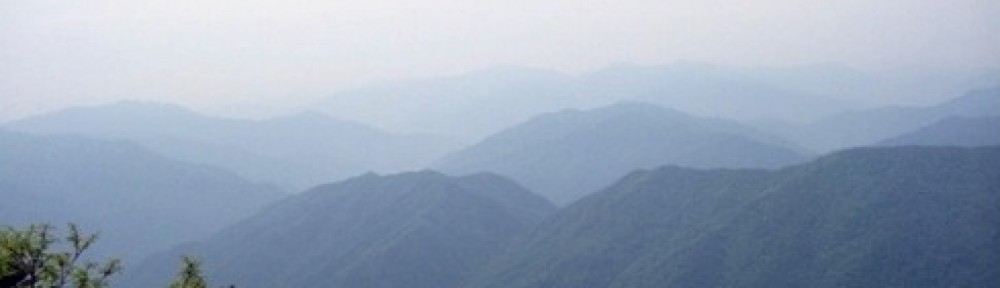
The Sanjo Melodies of the Winter River by Ku Sang

Translated by Chae-Pyong Song and Anne Rashid

Photo by Lee Sang-youp

The Sanjo Melodies of the Winter River by Ku Sang

Like attending a daily worship service,
on the early morning of a fierce December day,
today once more I have come out to the river.

As though its breathing stopped, the river has no single ripple,
even the sand bank across the way has a cold-stricken face,
all the ships shrink on the shore,
a few waterfowl strike water
and fly to the frozen sky.

In this desolation that is like the season’s grave,
how surprising it is to hear the celebratory tunes.

From my heart, not from the corpse-like river,
The Sanjo melodies of the grand bamboo flute ring.
From the springs of mountaintops near and far
There is the sound of a drop of dew piercing the crust of the earth,
the sound that the water of the valley pushes through the forest of rocks,

the sound of the fall that rolls down a cliff of a thousand fathoms,
the sound of water that rolls in a large river
made up with rapids from this or that field,
the clap of thunder in the sky, sounds of rain and snowstorms,
the sound of each innumerable water drop rising, dying, forming, tangling and merging,
the fascinating sound, now a tune, like the river that flows in front of me,
has disappeared into the faraway distance,
and resonates, transformed into a godly tune,
and my past, present, and future
melt to flow into that divine tune.

겨울강 산조(散調) /구 상

섣달매운 날씨 이른 아침
마치 매일예배를 보듯
나는 오늘도 강에 나와 있다.

강은 숨을 죽이듯 물살 하나 없고
건너 모래톱도 추위에 질린 얼굴을 하고
배들은 모두 기슭에 움츠리고 있는데
흰 물새 몇 마리 강물을 차며
얼어붙은 하늘을 날고 있다.

헌데 계절의 무덤 같은 이 삭막 속에서
신이 같은 축주는 그 어인 일인가?

시신같은 저 강에서, 아니 내 가슴에서
대금의 산조가 울려오며
이 산 저 산봉우리 옹달샘에서
한 방울의 이슬이 땅껍질을 뚫는 소리
바위 숲을 헤쳐 나오는 계곡의 물소리,

천길 벼랑을 내려 구르는 폭포소리,
이 들판 저 들판에서 흘러나온 여울들이
대하를 이루어 출렁이는 강물소리,
하늘의 천둥소리, 비소리, 눈보라소리,
헤아릴 수 없는 낱낱의 물방울들이
낳고 죽고 맺고 엉키고 합치는 소리,
영절한 그 소리, 소리들을 내더니
이제 그 가락은 내 앞을 흐르는 강처럼
저 멀리 아득히 자취를 감추면서
영산회상으로 변하여 울려오고
나의 과거와 오늘도 미래도
그 신운에 녹아 흐른다.

Today by Ku Sang

Translated by Chae-Pyong Song and Anne Rashid

Photo by Lee Sang-youp

Today by Ku Sang

Today again I meet a day, a well of mystery.

Like a drop of that river extends to
a spring of a valley and then to
the faraway blue sea, for this day
the past, the future, and the present are one.

So does my today extend to eternity,
and right now I am living the eternity.

So, starting from today, I should live
eternity, not after I die,
and should live a life that deserves eternity.

I should live the life of a poor heart.
I should live the life of an empty heart.

오늘/ 구상

오늘도 신비의 샘인 하루를 맞는다.

이 하루는 저 강물의 한 방울이
어느 산골짝 옹달샘에 이어져 있고
아득한 푸른 바다에 이어져 있듯
과거와 미래와 현재가 하나다.

이렇듯 나의 오늘은 영원 속에 이어져
바로 시방 나는 그 영원을 살고 있다.

그래서 나는 죽고 나서부터가 아니라
오늘서부터 영원을 살아야 하고
영원에 합당한 삶을 살아야 한다.

마음이 가난한 삶을 살아야 한다.
마음을 비운 삶을 살아야 한다.


The River of Saint Christopher: Part Eleven by Ku Sang

Translated by Chae-Pyong Song and Anne Rashid

Seomjin River, Korea

The River of Saint Christopher: Part Eleven by Ku Sang

It was just water.
It was clear water.
A large body of water
was flowing endlessly.

Flowing, it was always
in the same place.
Staying in the same place,
it was fresh every moment.

Even though it was fresh,
it still connected to the past.
Tied to the past,
it was still tied to the future.

The past and the future tied,
only the present existed.
The present
has many faces.

With many faces,
it spoke in many voices.
With many voices,
it was indifferent to all things.

While indifferent, it was in agony;
while in agony, it was indifferent.
Dying indifferently;
In dying, it has returned.

그리스도 폴의 강 11/ 구 상

그저 물이었다.
맑은 물이었다.
많은 물이 하염없이
흘러가고 있었다.

흘러가면서 항상
제자리에 있었다.
제자리에 있으면서
순간마다 새로웠다.

새로우면서 과거와
이어져 있었다.
과거와 이어져 있으면서
미래와 이어져 있었다.

과거와 미래가 이어져서
오직 현재 하나였다.
오직 하나인 현재가
여러 가지 얼굴을 하였다.

여러 가지 얼굴을 하고서
여러 가지 소리를 내었다.
여러 가지 소리를 내면서
모든 것에 무심하였다.

무심하면서 괴로워하고
괴로워하면서 무심하고
무심하게 죽어 가고
죽어 가면서 되살아왔다.


The River of Saint Christopher: Part One by Ku Sang

Translated by Chae-Pyong Song and Anne Rashid

Westhampton, NY, Photo by Joon Park, ©2011 TalentShare

The River of Saint Christopher: Part One by Ku Sang

Fog
sits thickly
on the morning river.

As though rowing across the nirvana
a ferry travels
through the grand-white empty air.

Ashore, a magpie
flies up squawking
from the poplar branch.

The sand under water
becomes as clear
as a woman’s skin.

Schools of small fish
swim idly
in natural delight.

Breaking, the golden sunlight
makes a flower bed of dream.

Here, in this place,
I am not an animal who eats rice.

그리스도 폴의 강 1/ 구상

아침 강에
안개가
자욱 끼어 있다.

피안(彼岸)을 저어 가듯
태백(太白)의 허공속을
나룻배가 간다.

기슭, 백양목(白楊木) 가지에
까치가 한 마리
요란을 떨며 날은다.

물밑의 모래가
여인네의 속살처럼
맑아 온다.

잔 고기떼들이
생래(生來)의 즐거움으로
노닌다.

황금(黃金)의 햇발이 부서지며
꿈결의 꽃밭을 이룬다.

나도 이 속에선
밥 먹는 짐승이 아니다.

The Stars are Warm by Chung Ho-seung

Translated by Chae-Pyong Song

Olympic National Park, Washington, Photo by Joon Park, ©2011 TalentShare

The Stars are Warm by Chung Ho-seung

The sky has eyes.
I don’t have to be afraid.
When in dark, dark winter
I walk on the snow-covered barley field
and meet the night without dawn,
the stars rising above the sky of my poverty
are warm.

To me
time for truth is already late;
what I once called Forgiveness
was all lies.
But, when I walk on the street of dawn the North wind has passed
and meet the night without dawn,
the stars rising above the sky of my death
are warm.

별들은 따뜻하다 / 정호승

하늘에는 눈이 있다
두려워할 것은 없다
캄캄한 겨울
눈 내린 보리밭길을 걸어가다가
새벽이 지나지 않고 밤이 올 때
내 가난의 하늘 위로 떠오른
별들은 따뜻하다

나에게
진리의 때는 이미 늦었으나
내가 용서라고 부르던 것들은
모든 거짓이었으나
북풍이 지나간 새벽거리를 걸으며
새벽이 지나지 않고 또 밤이 올 때
내 죽음의 하늘 위로 떠오른
별들은 따뜻하다

(Darcy Brandel and Anne Rashid read the earlier versions of this translation.)

Chung Ho-seung was born in 1950, in Hadong, Gyongsangnam-do. Since his debut in 1972 with a poem featured in the Korea Daily News, Chung has published many poetry collections, such asFrom Sorrow to HappinessJesus of Seoul, and Dawn Letter, which has achieved both critical acclaim and mass appeal. His minimal verse style interweaves the everday and the fantastic, proposing the possibility of lyrical revelation in even the most prosaic encounters.

To the Poor Person by Chung Ho-seung

Translated by Chae-Pyong Song

Painted by Kim Seon-soo

To the Poor Person by Chung Ho-seung

Today again, for you
I hung a lamp outside the window.
Today again, I couldn’t wait for you any longer,
and I hung a heart outside the window.
Night has come, wind blows,
and at last snow falls.
I couldn’t wait for you any longer,
and I became a man of poor heart.
I became a man who suddenly thinks of a star
as I walk alone on the snow-covered field.

가난한 사람에게/ 정호승

내 오늘도 그대를 위해
창 밖에 등불 하나 내어 걸었습니다
내 오늘도 그대를 기다리다 못해
마음 하나 창 밖에 걸어두었습니다
밤이 오고 바람이 불고
드디어 눈이 내릴 때까지
내 그대를 기다리다 못해
가난한 마음의 사람이 되었습니다
눈 내린 들길을 홀로 걷다가
문득 별을 생각하는 사람이 되었습니다

(Darcy Brandel and Anne Rashid read the earlier versions of this translation.)

Chung Ho-seung was born in 1950, in Hadong, Gyongsangnam-do. Since his debut in 1972 with a poem featured in the Korea Daily News, Chung has published many poetry collections, such asFrom Sorrow to HappinessJesus of Seoul, and Dawn Letter, which has achieved both critical acclaim and mass appeal. His minimal verse style interweaves the everday and the fantastic, proposing the possibility of lyrical revelation in even the most prosaic encounters.