An Ink Painting by Kim Jong-sam

Translated by Chae-Pyong Song and Anne Rashid

Painted by Jam San

An Ink Painting by Kim Jong-sam

The grandmother puts her hand
on the nape of the drinking cow’s neck.
To say, we have been through
another day together,
the backs of our feet are swollen,
and both of us are lonely.

묵화(墨畵)  /  김종삼

물먹는 소 목덜미에
할머니 손이 얹혀졌다.
이 하루도
함께 지났다고,
서로 발잔등이 부었다고,
서로 적막하다고,

One Pebble by Kim Nam-ju

Translated by Chae-Pyong Song and Anne Rashid

One Pebble by Kim Nam-ju

Between the sky and the earth
not a single breeze stirred, and I could not breathe.

That stifling, heart-wrenching day
my friend and I walked along the bank.
I told him we would become pebbles—
small stones
that would create a little ripple on the river
and disappear quickly.

On a dark night without sunlight
I told him we would become a spark—
a light
that would flicker like a firefly
and die out as soon as dawn breaks.

I didn’t ask my friend then,
how much of history would depend on the pebble?
I didn’t ask my friend then,
how much darkness would the light push away?
I was just content to have a friend
with whom I could share death.

돌맹이 하나/ 김남주

하늘과 땅 사이에
바람 한점 없고 답답하여라

숨이 막히고 가슴이 미어지던 날
친구와 나 제방을 걸으며
돌멩이 하나 되자고 했다
강물 위에 파문 하나 자그맣게 내고
이내 가라앉고 말
그런 돌멩이 하나

날 저물어 캄캄한 밤
불씨 하나 되자고 했다
풀밭에서 개똥벌레쯤으로나 깜박이다가
새날이 오면 금세 사라지고 말
그런 불씨 하나

그때 나 묻지 않았다 친구에게
돌에 실릴 역사의 무게 그 얼마일 거냐고
그대 나 묻지 않았다 친구에게
불이 밀어낼 어둠의 영역 그 얼마일 거냐고
죽음 하나 같이할 벗 하나 있음에
나 그것으로 자랑스러웠다

Kim Nam-ju (1946-1994) was born in Haenam, Jeollanam-do and studied English at Chonnam National University. He is known as one of the major resistance poets in South Korea, leading the people’s movement in the 1970s and 80s that ultimately toppled the dictatorship in Korea. Because of his activism, he was imprisoned twice, for more than ten years in total. In prison where paper and pencil were not allowed, he wrote many poems on milk cartons with the nail he made by grinding a toothbrush. These poems were later published in two collected volumes of his prison poetry, The Sunlight on the Prison Bar. His poetry bears witness to the tyranny of dictatorship and the hardships of the oppressed. He published such poetry collections as Requiem, My Sword My Blood, One Fatherland, The Weapon of Love and In This Lovely World. He received the Yun Sang-won Literary Award in 1993 and the National Literary Award in 1994. His poems have also been memorialized by Korean activist, rock singer An Chi-hwan in his album entitled “Remember.”


The Spring of Jiri Mountain by Koh Jung-hee

Translated by Chae-Pyong Song and Anne Rashid

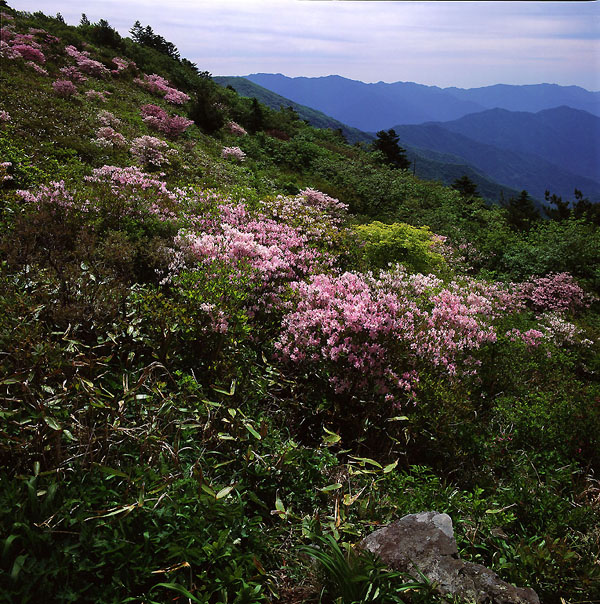
Jiri Mountain; photography by Ha Sung-mok


The Spring of Jiri Mountain
Part I: A Letter Written at the Snake Valley

Passing by the Sumjin River bend,
I have seen a light rising, flashing
over the southwest wind, lying down at the reed field.
The tail of the light follows me,
exposing the damp loneliness
that flows between my ribs,
bursting a single blossom of mountain magnolia.
This cool scent that coils around my whole body,
hung on the mountaintop of the Snake Valley.
May’s splendid sunlight sheds a long light
through the verdant green,
ruffling its sorrowful feathers,
opening a way to get to you.
You who stand upon the faraway ridge,
you who cross over the valley with deafening thunder–
when I climb the ravine, following you who are ahead of me,
the sticky darkness that I couldn’t shed for thirty years
is washed away clean by the grand rapids;
capillary vessels whose six thousand knots are untied
overflow with spring water;
from between heated flesh and bones
the laughing sound of fully blooming violets
transforms into you, the beautiful,
and climbs over the mountain,
ascending to heaven
like cloud, like wind.

(Originally published in The Gwangju News, August, 2011)

Koh Jung-hee (1948 – 1991) was born in Haenam, Jeollanam-do, and studied at Hanshin University. A passionate feminist, she often offered sharp criticism on modern Korean society, whether it was political oppression or gender inequality. In June, 1991, she died, swept up by a torrential rain, while climbing up the Snake Valley of Jiri Mountain, a mountain she loved a great deal and wrote about often. Known for resistance poetry, particularly based upon the Gwangju Uprising, as well as for lyric poems, she derived many of her poetic inspirations from Gwangju and Jeolla-do (often known as Nam-do). In her lifetime she published at least ten collections of poetry and received the Korean Literature Award in 1983.
Spring Garlic by Jung Kut-byol

Translated by Chae-Pyong Song and Anne Rashid


Spring Garlic by Jung Kut-byol

Like an obscenity, like a clenched fist,
a white garlic clove writhes;
I rub my burning eyes.
The breath-taking intensity
careens like an explosion:
dark green spring garlic mixed with pepper paste
between lettuce and pepper–
the garlic flower of Namdo, South Province,
white with a garlic scent.
Oh, the fresh spring night.
Feel the sensuous energy
that rolls up–
not a flower,
not a plant.
Shhh! Shhh!
See how it spews its venom, courageous,
like a guerilla, into the spring sea.
Spring garlic mixed with pepper paste
between lettuce and green pepper–
the Namdo seed garlic, white with a garlic scent.

Jung Kut-byol (1964-) was born in Naju, Jeollanam-do. She is a professor of Korean literature at Myungju University in Seoul.  Working as both a poet and a critic, she has published four poetry collections: My Life: a Birch Tree (1996), A White Book (2000), An Old Man’s Vitality (2005) and Suddenly (2008), along with two collections of critical essays: The Poetics of Parody (1997) and The Language of Poetry Has a Thousand Tongues (2008).  She has also edited an anthology entitled In Anyone’s Heart, Wouldn’t a Poem Bloom?: 100 Favorite Poems Recommended by 100 Korean Poets (2008).