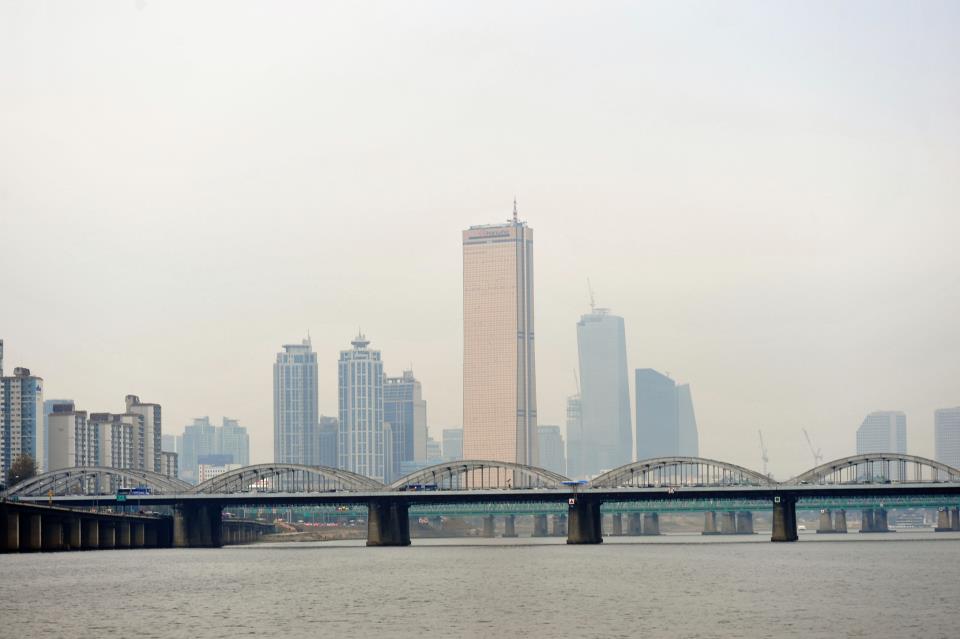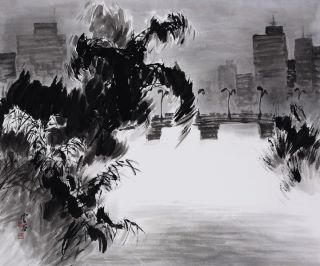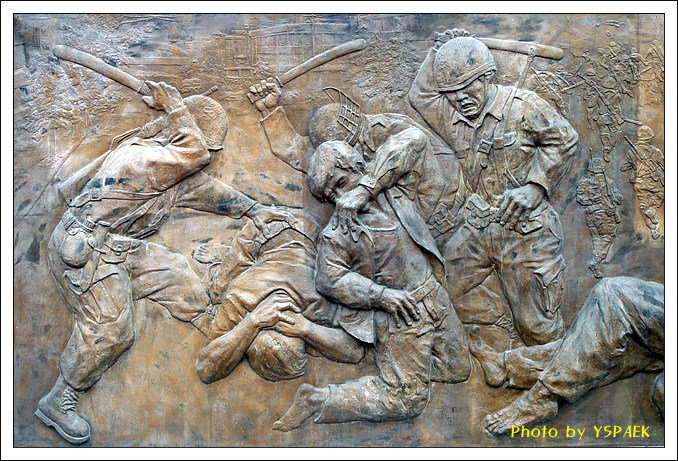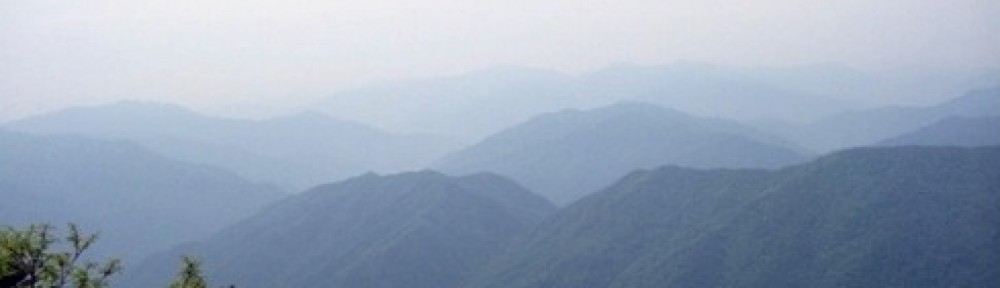
The Horizon by Kim Hye-soon

Translated by Chae-Pyong Song

Photographed by Chae-Pyong Song

The Horizon by Kim Hye-soon

Who broke it?
The horizon beyond,
the fissure between heaven and earth,
an evening where crimson water spreads out from the gap.

Who broke it?
The slit between upper and lower eyelids,
The scars of my body broken because of emptiness within and without,
an evening where tears erupt from the gap.

Can only a wound flow into a wound?
The glow of sunset rushes toward me as I open my eyes.
When a wound touches a wound,
red water flows without end.
Even the exit, disguised as you, shuts in darkness.

Who broke it?
The white day from the dark night.
During the day she becomes a hawk,
at night he becomes a wolf.
Through the gap, the evening of our encounter
brushes by like a knife blade.

(Originally published in Azalea: Journal of Korean Literature and Culture, Volume 3, 2010)


A Sand Woman by Kim Hye-soon

Translated by Chae-Pyong Song and Anne Rashid

Photographed by Lee Sang Youp

A Sand Woman by Kim Hye-soon

From inside sand a woman was lifted up—
she was intact, not even a hair damaged

After his departure she hadn’t slept or eaten, it was said–
though she kept her eyes closed,
and wasn’t breathing,
she wasn’t dead

People came and took her away—
they undressed her, immersed her in salt water, parted her legs,
cut her hair, opened her chest, I was told

Though they said he had died at the battlefield
and even though the country she left was far away,
the woman held her breath
and didn’t release it into the world—
though knife blades went in and out of her body, she would not open her eyes.

They sewed her up again and laid her down inside a glass case—
he, whom she had been awaiting, didn’t come, but from four corners fingers pressed in

Every day I looked down vacantly
on two hands they laid out on paper–
after they lifted up the woman hidden inside sand,
I wanted to escape far away from here on a camel

In every dream the woman followed me
and opened her closed eyes like a flash—
the insides of her eyelids were wider and deeper than the desert’s night sky

(Originally published in The Korea Times, November 2, 2009)

Kim Hye-soon was born in 1955 at Uljin, North Gyeongsang Province. She graduated from Konkuk University majoring Korean literature and started writing poems from there.
Her literary career took off when she debuted with her poem “The Corpse that Smokes Cigarettes” in 1979. In 1997, she received the Kim Su-young Literature Award and also the Korean Poetry Award in 2000. She is currently a professor at the Creative Writing department of Seoul Institute of the Arts.

Snow Falls on the Subway by Yoon Zelim

Translated by Chae-Pyong Song and Anne Rashid

The Han River, photographed by Kim Jaegon

Snow Falls on the Subway by Yoon Zelim

To cross the river
the subway rises above ground
An ajumma[1] sits silently
nudging her companion’s side to say
the snow is falling
An old man in the next seat shakes his grandson
whose eyes are half closed
and points outside the window with a part of his finger missing
the snow is falling
A young man and woman who have been standing sullenly
turn to look at each other
the snow is falling
A red-haired girl who sits reading a comic book
swiftly pulls out her cell phone
the snow is falling

Snow is falling on the Han River[2]
Snow is falling on the subway
All are grateful
when the subway comes above ground momentarily

지하철에 눈이 내린다/ 윤제림

강을 건너느라
지하철이 지상으로 올라섰을 때
말없이 앉아 있던 아줌마 하나가
동행의 옆구리를 찌르며 말한다
눈 온다
옆자리의 노인이 반쯤 감은 눈으로 앉아 있던 손자를 흔들며
손가락 마디 하나가 없는 손으로
차창 밖을 가리킨다
눈 온다
시무룩한 표정으로 서 있던 젊은 남녀가
얼굴을 마주 본다
눈 온다
만화책을 읽고 앉았던 빨간 머리 계집애가
재빨리 핸드폰을 꺼내든다
눈 온다

한강에 눈이 내린다
지하철에 눈이 내린다
지하철이 가끔씩 지상으로 올라서 주는 것은
고마운 일이다

(Originally published in _list: Books from Korea, Vol. 9 (Autumn 2010)

Dawn on the Han River, painted by Kang Jang-won


[1] A common Korean term for a middle-aged married woman

[2] A river that runs through Seoul

The Road to the Sana Temple by Yoon Zelim

Translated by Chae-Pyong Song and Anne Rashid

"The Road to Seonam Temple" by Shin Kyong-wook

The Road to the Sana Temple by Yoon Zelim

Passing an old man thrashing sesame plants,
passing a pregnant woman
who stands with an umbrella for a parasol
watching young maple foliage on a cliff,
passing a middle-aged man
who sits in a taxi with the off-duty sign on
waiting for his wife who is inside the mobile lavatory,
passing the lovers
who crouch on the stepping stones–
under the late autumn sunlight, the trout and salmon weave giddy patterns;
they point at them again and again,
saying the water is so clear, the fish are so many

Passing the passing spring water,
passing the passing trees,
passing the passing rain—
the people of the river village

사나사 가는 길/ 윤제림 

참깨를 터는 중늙은이를 지나서
우산을 양산 대신 쓰고
벼랑 위의 아기단풍을 구경하고 서 있는
배부른 여자를 지나서
쉬는 차 표지가 보이는 개인택시를 세워놓고
이동화장실에 들어간 아내를 기다리는
중년의 사내를 지나서
늦가을 햇살에 산천어 열목어가 어질어질
물무늬를 놓고 있는 징검다리에 쪼그리고 앉아
물 참 맑다, 고기 참 많다
연신 손가락질을 해대고 있는
연인들을 지나서

지나가는 샘물을 지나서
지나가는 나무를 지나서
지나가는 비를 지나서.
강(江)마을 사람들

(Originally published in _list: Books from Korea, Vol. 9 (Autumn 2010)


Epitaph in the Mangwol Cemetery by Koh Jung-hee

Translated by Chae-Pyong Song and Anne Rashid

Photographed by Y.S. Paek

Epitaph in the Mangwol Cemetery:
In Memory of Hwang Il-bong

How could the karma ravaging one generation
only affect the souls sleeping at Mangwol cemetery?
They started a seed fire to the stacks of the age of darkness,
opening up the wide sky.
They were buried, burnt up like the charcoal of the Hwangsan battlefield.
Today they stop the passing Moon and question.
They ask about the wages of my sin.
How could the scars of the knife that ravaged one generation
be only the wages of my sin?
When I face the Moon, I feel like a philistine,
and know a bunch of mums is just not enough.
As I meet with your only remaining eye, rising as the Moon,
I feel ashamed.
Today all I add is my helplessness,
my light that won’t even cover up one plot.

망월리 비명(碑銘) – 황일봉에게 / 고정희

한 세대 긋고 지난 업보가 어디
망월리에 잠든 넋뿐이랴만
한 시대가 쌓아올린 어둠의 낟가리에
불쏘시개 되어 하늘 툭 틔우고
황산벌 숯가마로 묻힌 저들이
오늘은 가는 달 붙잡고 묻는구나
내 죄값을 달에게 묻는구나
한 세대 긁고 지난 칼 자국이
어디 내 죄값뿐이랴만
내가 달과 마주 서니 속물일 뿐이어서
국화 한 다발도 속될 뿐이어서
달로 떠오르는 네 외짝눈과 만나니
부끄럽구나
한 평 땅 덮지 못할 내 빛
무력한 근심이나 보태는 오늘

All Things that Disappear Leave a Space Behind by Koh Jung-hee

Translated by Chae-Pyong Song and Anne Rashid

Painted by Kang Jang-won

All Things that Disappear Leave a Space Behind by Koh Jung-hee

Mother who sleeps in the grave
has left a large space in the family graveyard–
she has left a space larger than her words.
At dusk, I hike up the hill
and sit under the space of the red pine field.
All kinds of trivial talk that I picked up from Seoul,
following the stream of Release,
flow into the middle of the field and then into the sea.
Things that flow into the sea and remain invisible,
becoming the tight wind that strikes the mountain bird’s ankle,
raise a greater space once more
and disappear down a faraway trail.

The round space, the byway
that remains behind all the things that disappear!
The existence that rises up after all the absence!
The space is loneliness,
loneliness is also a space,
so the space is creation.

The day I disappear from you,
after all the weeds of my heart are gone,
I too want to remain as a tranquil space,
like an evening glow hung over your twig gate
or a creek swiftly flowing under your feet,
under the space where you sit.

모든 사라지는 것들은 뒤에 여백을 남긴다/ 고정희

무덤에 잠드신 어머니는
선산 뒤에 큰 여백을 걸어두셨다
말씀보다 큰 여백을 걸어두셨다
석양 무렵 동산에 올라가
적송밭 그 여백 아래 앉아 있으면
서울에서 묻혀온 온갖 잔소리들이
방생의 시냇물 따라
들 가운데로 흘러흘러 바다로 들어가고
바다로 들어가 보이지 않는 것은 뒤에서
팽팽한 바람이 멧새의 발목을 툭, 치며
다시 더 큰 여백을 일으켜
막막궁산 오솔길로 사라진다

오 모든 사라지는 것들 뒤에 남아있는
둥근 여백이여 뒤안길이여
모든 부재 뒤에 떠오르는 존재여
여백이란 쓸쓸함이구나
쓸쓸함 또한 여백이구나
그리하여 여백이란 탄생이구나

나도 너로부터 사라지는 날
내 마음의 잡초 다 스러진 뒤
네 사립에 걸린 노을 같은, 아니면
네 발 아래로 쟁쟁쟁 흘러가는 시냇물 같은
고요한 여백으로 남고 싶다
그 아래 네가 앉아 있는


The Wine Barrel and the Country Road by Song Su-kwon

Translated by Chae-Pyong Song and Anne Rashid

Painted by Kim Seon-soo

The Wine Barrel and the Country Road by Song Su-kwon

The wine barrel jostles on the bike carrier.
The grass smell turns the spokes.
The spokes make the wine splash.
The gravel jumps up over the barrel
and falls on the grass field.
The country road drinks wine–
it wobbles.
The joy of the barrels that run to the tavern:
a barmaid stands outside.
The barrels jump down.
The road goes into her skirt and ends.

시골길 또는 술통 / 송수권

자전거 짐받이에서 술통들이 뛰고 있다
풀 비린내가 바퀴살을 돌린다
바퀴살이 술을 튀긴다
자갈들이 한 치씩 뛰어 술통을 넘는다
술통을 넘어 풀밭에 떨어진다
시골길이 술을 마신다
비틀거린다
저 주막집까지 뛰는 술통들의 즐거움
주모가 나와 섰다
술통들이 뛰어내린다
길이 치마 속으로 들어가 죽는다

My Wife’s Bare Foot: Turtle Shell Letters by Song Su-kwon

Translated by Chae-Pyong Song and Anne Rashid

My Wife’s Bare Foot: Turtle Shell Letters by Song Su-kwon

I once saw a turtle die on en route back to the sea
after she had dug up a hole in the hot sand with her hind legs,
laid a few eggs and covered it back up with sand.
Her body was turned over, her short front paws were folded,
she was lying with the soles of her hind legs pointing toward the sky.

The unusually long soles of her feet looked sad.

Toward the anesthesia room, where nobody knows when she will awake,
passing all the patients’ rooms whose lights are turned off,
the bed carriage rolls on.
With a white mask on, her two eyes closed,
her bare feet poking out of the sheet

My wife’s soles were broken up
like the turtle shell soles that looked like ancient letters.

아내의 맨발
–갑골문 甲骨文 /송수권

뜨거운 모래밭 구멍을 뒷발로 파며
몇 개의 알을 낳아 다시 모래로 덮은 후
바다로 내려가다 죽은 거북을 본 일이 있다
몸체는 뒤집히고 짧은 앞 발바닥은 꺾여
뒷다리의 두 발바닥이 하늘을 향해 누워있었다

유난히 긴 두 발바닥이 슬퍼 보였다

언제 깨어날지도 모르는 마취실을 향해
한밤중 병실마다 불꺼진 사막을 지나
침대차는 굴러간다
얼굴엔 하얀 마스크를 쓰고 두 눈은 감긴 채
시트 밖으로 흘러나온 맨발

아내의 발바닥에도 그때 본 갑골문자들이
수두룩하였다.

The Gnarled Tree by Shin Byong-eun

Translated by Chae-Pyong Song and Anne Rashid

Painted by Kang Jang-won

The Gnarled Tree by Shin Byong-eun

To become wholly a part of you is to harden

the white wind that has stormed together, shaken the core,

and slipped through the top of my head.

To build a strong house on the edge of the wind

is part of the scar I must never forget.

옹이/ 신병은

진정으로 그대의 한 부분이 되는 일은 오랜 세월 떼

지어 다니며 중심을 흔들다 정수리를 빠져나간 하얀 바람

소리를 다지는 일이다

잊어서는 안 될 상처의 한 부분을 위해 그 바람의

기슭에 단단한 집을 짓는 일이다

Shin Byong-eun (1955 – ) was born in Changnyong, Gyongsangnam-do. His poetry collections include Blades of Grass with WindGreeting the Vegetable MorningThe Sleep of Grasses on the Other Side of the RiverHow to Fire Wind, and The Scenery of Poems and Paintings. He was awarded the Jeonnam Poetry Award, the Yeosu Arts and Culture Award, and the Hanryo Literary Award. Currently he teaches at Yeosu Information Science High School and serves as a chairperson of Yeosu Branch of the Federation of Arts and Culture Organizations of Korea.